Skip to content



Before we get into the details, a quick orientation: the mechanics of rolling a 401(k) into a Silver IRA are the same as rolling a 401(k) into a Gold IRA. Same IRS framework, same self-directed account structure, same custodian-and-depository workflow. What this guide focuses on is the why for silver specifically. Silver behaves differently than gold in a portfolio, has its own demand story tied to industry and technology, and is currently in the middle of one of the most talked-about runs in the precious metals market. If you already understand the gold rollover side of things, the process here will feel familiar. If you don’t, everything you need is below.
When markets feel unsteady, inflation eats into household budgets, and headlines about rate cycles and geopolitics dominate the news, retirement savers reasonably start asking whether they should be holding something more tangible to protect their retirement savings alongside their stocks and bonds. For a growing number of those savers, the answer is yes, and silver is increasingly the metal at the center of that conversation. This 401(k) to Silver IRA rollover guide covers what the move involves, how it works under IRS rules, what makes silver distinct as a retirement asset, and how Noble Gold Investments handles every step on your behalf.
Why Silver, And Why Now?
Silver is in the middle of a genuine, data-backed boom, and it is one of the reasons interest in Silver IRAs has accelerated over the last twelve months. A few numbers help put the move into perspective.
- Silver rallied roughly 147% during 2025, one of its strongest calendar years on record.
- On January 29, 2026, silver printed a new nominal all-time high of $121.64 per ounce, eclipsing the 1980 Hunt-brothers peak that had stood for more than four decades.
- Even after a healthy pullback, silver continues to trade well above its multi-year range, anchored by a structural supply shortfall rather than a one-off spike in speculation.
- The Silver Institute’s World Silver Survey 2026 projects a global market deficit of roughly 215 million ounces this year, the sixth consecutive annual deficit and the largest on record.
Underneath the price action, the demand story is what makes silver distinct from gold. Roughly half of all silver gets used in industry, not jewelry or coinage, and that share is being pushed higher by some of the largest spending themes of the decade.
- Solar photovoltaics. Solar panel manufacturing now consumes around 130 million ounces of silver each year, up from about 11% of total silver demand in 2014 to roughly 29% in 2024.
- Electric vehicles. Battery-electric cars use an estimated 25 to 50 grams of silver per vehicle, roughly 67% to 79% more than a comparable internal-combustion vehicle.
- Data centers and AI infrastructure. High-performance servers, advanced semiconductors, and 5G hardware all rely on silver’s unmatched conductivity, and demand from this segment is forecast to keep rising through 2030.
- Medical and defense applications. Antimicrobial coatings, surgical devices, and specialized aerospace and defense systems continue to draw on silver as well.
Supply, meanwhile, has trouble keeping up. More than 70% of newly mined silver comes out of the ground as a by-product of copper, lead, zinc, or gold mining, which means producers cannot simply turn the taps on when the silver price rises. That bottleneck is part of why the Silver Institute expects a sixth straight year of deficit in 2026.
One more datapoint worth knowing: the gold-to-silver ratio. At the start of 2025 it sat near 88, meaning one ounce of gold cost the same as 88 ounces of silver. By early 2026 it had compressed to roughly 60, very close to the long-term average. Investors who watch this ratio see silver’s recent outperformance as part of a long-overdue catch-up trade rather than a peak.
Past performance is not a guarantee of future results, and silver is historically more volatile than gold. But the combination of record industrial demand, a multi-year supply deficit, and renewed retail and institutional investment interest is exactly the backdrop many investors look for when adding a hard asset to their retirement portfolio.
Ready to Learn More?
Schedule a complimentary strategy call with one of our specialists today.
No pressure, no sales-y jargon, just clear and honest guidance to help you invest with confidence.
INVESTMENTS
SECURE


What Is A Silver IRA Rollover?
A Silver IRA rollover is the process of moving funds from an existing retirement account into a self-directed IRA that holds IRS-approved physical silver. Handled correctly, the transaction is a non-taxable event. Your retirement dollars keep their tax-advantaged status, and you owe no income tax and no early-withdrawal penalty.
Which Accounts Can You Roll Into A Silver IRA?
- Traditional 401(k)
- Roth 401(k)
- 403(b)
- 457(b)
- Thrift Savings Plan (TSP)
- Traditional, Roth, or SEP IRA
Which Accounts Are Not Eligible For A Silver IRA Rollover?
- An active 401(k) at your current employer, unless your plan specifically permits in-service distributions (usually only at age 59½ or older).
- Required Minimum Distributions (RMDs) once you have reached RMD age (currently 73).
- Hardship withdrawals taken from a 401(k).
- Substantially equal periodic payments under IRC §72(t).
- Outstanding 401(k) loan balances.
- Inherited IRAs from a non-spouse, which must stay in an inherited IRA structure.
- SIMPLE IRAs during the first two years of participation.
- Health Savings Accounts (HSAs).
- 529 college savings plans.
- Coverdell Education Savings Accounts (ESAs).
- Non-qualified annuities purchased outside of a retirement plan.
- Pension or 401(k) payments being received as a fixed lifetime annuity.
What Are The Benefits Of A 401(k) To Silver IRA Rollover?
A Silver IRA rollover is not about chasing the next hot return. It is about giving the rest of your portfolio a sturdier foundation by adding an asset with its own demand drivers and its own behavior in the face of market stress.
What Are The Key Benefits At A Glance?
- A dual-demand profile. Silver is both a monetary metal and an industrial metal. That gives it two engines: investment demand during periods of inflation or market stress, plus industrial demand from solar, EVs, electronics, and medical devices.
- Inflation protection. Like gold, silver has historically held purchasing power as the cost of living climbs, which is why it is often included in long-term inflation hedges.
- Portfolio diversification. Silver’s price moves are historically uncorrelated with stocks and bonds, and it has frequently moved in the opposite direction of equities during major market drawdowns.
- Lower entry price per ounce. Because silver trades for a fraction of the price of gold, investors can build out a more granular, easier-to-divide position. That can be useful both for dollar-cost averaging in and for taking partial distributions later.
- Higher historical upside in bull cycles. Silver is more volatile than gold in both directions, and in past precious-metals bull markets it has tended to outperform gold once a rally is established.
- No counter-party risk. Physical silver is no one’s liability. It cannot default, miss earnings, or be diluted by a secondary offering.
- Tax-advantaged growth. Traditional Silver IRAs grow tax-deferred, much like a Traditional IRA, and follow standard annual contribution limits. Roth Silver IRAs grow tax-free, similar to a standard Roth IRA, with qualified withdrawals also tax-free.
- Tangible ownership. Your IRA owns specific, allocated coins and bars held in your name at a depository. At distribution, you can choose to take physical silver in-kind rather than cash.
- Peace of mind. Holding a portion of your retirement in a physical, time-tested asset gives many investors the confidence to stay the course through volatile periods in their paper holdings.
If precious metal IRAs are new territory for you, our Gold and Silver Investing Guide is a useful companion piece and a good place to start before committing to a particular metal mix.
What Key Rules Should You Know Up Front?
- Self-directed structure required. Standard brokerage IRAs are not set up to hold physical metals as an investment option.
- IRS-approved depository only. You cannot legally store IRA silver at home, in a safe deposit box, or inside a personal LLC.
- Section 408(m) carve-out. This is the section of the Internal Revenue Code that defines prohibited collectibles but allows specific bullion to sit inside an IRA.
- Tax treatment follows the destination IRA. Roll into a Traditional Silver IRA for tax-deferred growth, or a Roth Silver IRA for tax-free growth on qualified withdrawals.
- Only specific products qualify. Eligible silver must meet minimum purity standards, with one named statutory exception.
IRS Minimum Purity Standards
| Metal | Minimum Fineness | Notable Exception |
| Silver | 99.9% | The American Silver Eagle (.999 fine) is named explicitly in the Internal Revenue Code under IRC §408(m)(3)(A)(iv), giving it an unambiguous statutory carve-out. |
| Gold | 99.5% | The American Gold Eagle (91.67% pure) is allowed by name in the Internal Revenue Code. |
| Platinum | 99.95% | None. |
| Palladium | 99.95% | None. |
New to silver investing? Our Gold and Silver Guide walks through how precious metals and key considerations to think about before getting started.
Ready to Learn More?
Schedule a complimentary strategy call with one of our specialists today.
No pressure, no sales-y jargon, just clear and honest guidance to help you invest with confidence.
INVESTMENTS
SECURE
How Does A 401(k) To Silver IRA Rollover Work?
The mechanics of a 401(k) to Silver IRA rollover get a lot less intimidating once you see them laid out side by side. The IRS recognizes two paths: a Direct Rollover and an Indirect Rollover. Each one has its own process, its own timing, and its own tax treatment.
Direct vs. Indirect Rollover at a Glance
| Feature | Direct Rollover | Indirect Rollover |
| How funds move | Your plan administrator sends the funds directly to your new IRA custodian. | You receive the funds first, then redeposit them into your new IRA yourself. |
| Federal tax withholding | None. | 20% mandatory withholding from a qualified plan; you must make up that amount from other funds to roll the full balance. |
| Deadline | No 60-day clock. | Must be redeposited within 60 calendar days. |
| Risk if mishandled | Minimal. | Missing the deadline turns it into a taxable distribution, plus a 10% penalty if you are under 59½. |
| Noble Gold recommendation | Preferred in nearly every situation. | Only when a direct rollover is not available. |
What Are The Five Steps Of A Silver IRA Rollover?
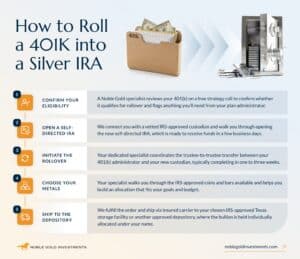
Step 1: Confirm your eligibility. You can roll over a 401(k) as soon as you become eligible to take a distribution from it. If you have already separated from the employer that sponsored the plan, you can roll the account over whenever you choose. If you are still working there, an in-service rollover only happens if the plan document allows it, and most plans that do permit it limit the option to participants age 59½ or older.
Where Noble Gold comes in: A specialist reviews your specific situation on a free strategy call and tells you upfront whether your plan qualifies and what (if anything) you’ll need from your administrator before moving forward.
Step 2: Open a self-directed IRA. A Silver IRA has to be self-directed, because traditional brokerage IRAs are not set up to custody physical metals as an investment option. You’ll open a new self-directed IRA account with an IRS-approved trust company (your Silver IRA custodian), which holds the account on paper, processes the rollover, and records every transaction.
Where Noble Gold comes in: Your dedicated specialist personally walks you through every step of opening your self-directed IRA, working directly with our vetted IRS-approved custodian on your behalf to set the account up correctly, complete the paperwork, and verify every detail against current IRS rules. From there we structure the move as a clean, penalty-free direct, trustee-to-trustee rollover (the safest path to avoid the 60-day window, mandatory withholding, and early-withdrawal penalties) and stay engaged throughout as your guide and compliance safety net, so your retirement savings stay protected at every step.
Step 3: Initiate the rollover. Once your new IRA is open, you authorize your existing 401(k) plan to send the funds to your new custodian. A direct, trustee-to-trustee rollover typically takes one to three weeks, depending on how quickly the releasing plan processes the request.
Where Noble Gold comes in: Your dedicated specialist coordinates with both your 401(k) administrator and your new custodian, handles the paperwork on your behalf, and keeps the request moving so you aren’t chasing forms or sitting on hold.
Step 4: Choose your silver. Once the cash lands in your new IRA, you sign an investment direction form authorizing your custodian to purchase specific IRS-approved silver coins, bars, or rounds. Only products that meet IRS purity standards qualify (silver at 99.9%, plus the American Silver Eagle named exception), and other precious metals are available as well: gold at 99.5%, platinum and palladium at 99.95%.
Where Noble Gold comes in: Your specialist walks you through the eligible product menu, explains the differences between sovereign coins and refiner bars, points out where premiums sit, and helps you build an allocation that fits your goals and budget.
Step 5: Ship to the depository. Your custodian executes the purchase, and the silver is shipped directly to your IRS-approved depository (you cannot legally take personal possession of IRA metals). The depository inspects and verifies the bullion on arrival, then confirms receipt back to your custodian, who updates your account.
Where Noble Gold comes in: We fulfill the order through our network of mints and wholesale partners and ship via insured carrier to your chosen depository, including our segregated Texas storage facility for clients who want their silver individually allocated under their own name.
Click here to open an account and get started today.
Good to Know: The IRS “one-rollover-per-12-months” rule only applies to IRA-to-IRA rollovers. A direct 401(k)-to-IRA rollover does not use up that annual allowance, so rolling a 401(k) into a Silver IRA will not interfere with any other moves you might already have planned.
How Can Noble Gold Investments Help?
Reading a 401(k) to Silver IRA rollover guide is one thing. Actually executing the move with confidence is another. As a leading precious metals IRA company, Noble Gold Investments has spent more than two decades turning a process that sounds complicated on paper into something most clients describe as simple.
What You Can Expect From Our Partnership
- A dedicated U.S.-based specialist. One point of contact from your very first phone call through long after your account is funded. No rotating call-center hand-offs.
- A purpose-built self-directed Silver IRA. Designed specifically to hold IRS-approved physical metals, with transparent pricing and no hidden fees.
- Hands-on rollover coordination. We handle the back-and-forth with your 401(k) administrator and your custodian so the paperwork does not fall on your shoulders.
- IRS-approved depository network. Including our segregated Texas storage facility for clients who want their silver held domestically and individually allocated under their own name.
- Top-rated buyback program. If you ever decide to liquidate, we make the exit as smooth as the original purchase, with competitive pricing on the metals you already hold.
Whether you are rolling over a recently inactive 401(k) or finally putting an old plan from a former employer to work, a thoughtful Silver IRA rollover guide is only the starting point. The next move is yours, and Noble Gold is ready when you are.
Ready to Learn More?
Schedule a complimentary strategy call with one of our specialists today.
No pressure, no sales-y jargon, just clear and honest guidance to help you invest with confidence.
INVESTMENTS
SECURE
FAQs
- Do I have to roll over my entire 401(k), or can I move just a portion into silver?
No, most plans allow partial rollovers, so you can move only the portion you want into precious metals and leave the rest invested as is in mutual funds or stocks. Many investors allocate roughly 5% to 20% of their retirement assets to physical precious metals as a diversifier, with silver typically used either as a standalone allocation or alongside gold inside the same IRA. The right percentage is a personal decision a Noble Gold specialist can help you think through.
- Why is silver getting so much attention from retirement investors right now?
A combination of factors. Silver rallied roughly 147% during 2025 and printed a new all-time high above $121 per ounce in January 2026. The Silver Institute is projecting a record 215-million-ounce supply deficit in 2026, the sixth straight year of shortfall. At the same time, structural demand from solar panels, electric vehicles, and AI-related data center hardware keeps grinding higher. Layer in persistent inflation above the Fed’s 2% target and a heavily concentrated U.S. stock market, and you have a setup that has pushed many retirement savers to look at a physical metal with both monetary and industrial use cases.
- Can I do a rollover while I am still employed by the company that sponsors my 401(k)?
Sometimes yes, but it depends on your plan. Each 401(k) plan document decides whether to permit in-service distributions and on what terms. Most plans that allow them restrict eligibility to participants who have already reached age 59½. The cleanest way to check is to read your Summary Plan Description or call your plan administrator directly.
- How long does a 401(k) to Silver IRA rollover take from start to finish?
A direct rollover usually takes two to four weeks end to end, with the releasing 401(k) plan being the slowest step at roughly one to three weeks. Plans that still issue paper checks can stretch closer to four to six weeks, while plans that wire funds through the National Securities Clearing Corporation can complete the move in about a week.
- Will I owe any taxes or penalties on a 401(k) to Silver IRA rollover?
A direct trustee-to-trustee rollover is non-taxable, with no withholding and no early-withdrawal penalty even if you are under 59½. Your 1099-R will show distribution code G with a $0 taxable amount in box 2a. The two exceptions are missing the 60-day deadline on an indirect rollover (which becomes a fully taxable distribution plus a 10% penalty under 59½ per IRC §72(t)) and rolling pre-tax dollars into a Roth Silver IRA, which is taxable as a Roth conversion in the year you do it.
- What’s the difference between a rollover and a transfer?
A transfer moves funds directly between two retirement accounts of the same type (typically IRA to IRA) without you ever taking possession, and it is not reported to the IRS or subject to the one-per-12-months rule. A rollover either involves a move between different account types (like a 401(k) to an IRA) or an IRA-to-IRA move where you temporarily take possession of the funds, and it is reported to the IRS with a 60-day redeposit deadline.
- Should I choose silver, gold, or both inside my IRA?
Most clients hold both. Gold tends to be steadier and is often viewed as the core monetary hedge, while silver brings more upside potential in bull cycles plus exposure to industrial demand from technology, energy, and EVs. A common starting point is a weighted mix tilted toward gold for stability with a meaningful silver position layered in for growth, but the right blend depends on your timeline, risk tolerance, and what the rest of your portfolio looks like. A Noble Gold specialist can help you put numbers to that decision.